
Table of Contents
- Communication Foundations — The Two-Second Rule
- Compass Reference Systems — Numbers Never Lie
- The IGL Role — Decision-Making Framework
- Contact Reporting — Building the Intel Picture
- Rotation Calls — Moving as One
- Loot Distribution — Fair and Fast
- Revive Protocols — Safe Recovery
- Post-Match Review — Continuous Improvement
- Frequently Asked Questions
Communication Foundations — The Two-Second Rule
Every communication framework in competitive PUBG Mobile starts with the same principle: information must be delivered within two seconds. In the time it takes you to say a four-word sentence, a full squad can rotate, an enemy can peak a corner and knock your teammate, or a third party can open fire from a completely unexpected direction. Long callouts are not just inefficient — they are dangerous.
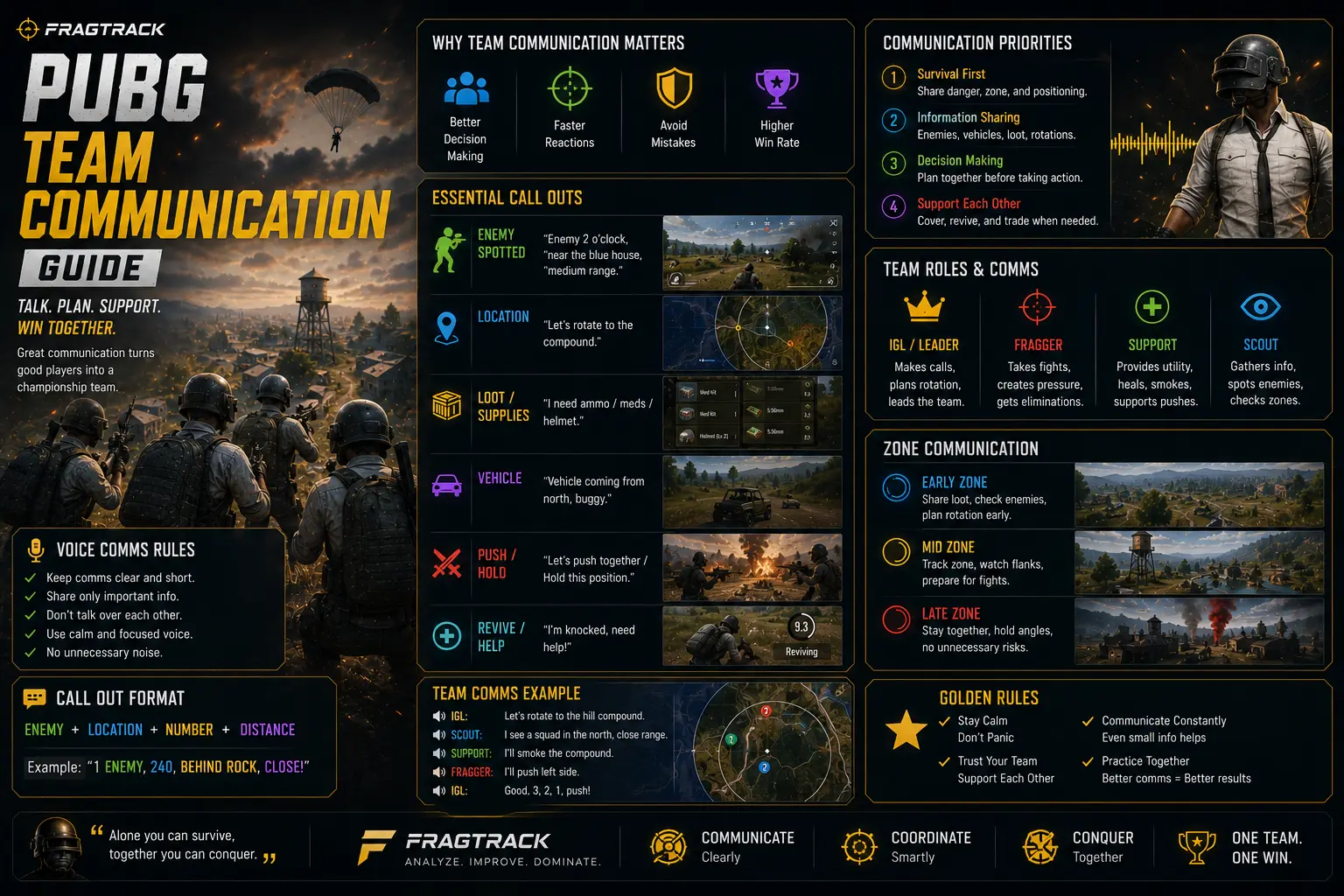
The Two-Second Callout System has three mandatory components: direction (compass number), distance (close/mid/far), and enemy action (pushing/rotating/farming/healing). A complete callout under this system sounds like: "280 close, one squad pushing warehouse." That callout gives your entire squad everything they need to react in under two seconds. Compare that to the common callout: "I think I see some guys over by that building near the warehouse, they might be coming this way." By the time you finish that sentence, the enemy has already closed 20 meters of distance and your squad is still processing what you said.
The 80-20 Comms Rule
80% of your squad's communication should happen before contact. Once the shooting starts, callouts should be minimal — compass number, knock confirmation, and reposition announcements. Pre-fight communication builds the plan; in-fight communication executes it. Teams that chatter during fights lose 40% more engagements than teams that go silent on contact.
Compass Reference Systems — Numbers Never Lie
The compass at the top of your screen is the single most underutilized tool in PUBG Mobile communication. It displays a 0-360 degree scale that corresponds to your character's facing direction. When you call out a compass number, every squad member can instantly look at their own compass and know exactly where the threat is — regardless of where they are looking or what direction they are facing.
Training your squad to use compass numbers takes practice. Start by having each squad member call out their own compass number every time they move during a looting phase: "Moving to 140." "At 60." "Rotating to 320." This builds the habit of thinking in compass terms. Once the habit is automatic, your squad will naturally call out enemy positions using the same system.
Important nuance: compass numbers are relative to each player's individual facing direction. This means "enemy at 90" is different for each squad member. To make callouts universally useful, also include a landmark reference: "Enemy at 90 on the blue car" or "Contact at 320, two-story building." The combination of compass number and landmark creates a callout that is both immediate and unambiguous.
The IGL Role — Decision-Making Framework
The In-Game Leader is the most important role in any PUBG Mobile squad. The IGL is responsible for every strategic decision: where the squad drops, when they rotate, which fights they take, and how they approach the end-game. A good IGL can elevate a squad of mechanically average players to Ace-tier performance. A bad IGL can waste the potential of four mechanically gifted players.
The IGL's decision-making framework should follow a clear hierarchy. First priority is survival: will this action keep the squad alive? Second priority is information: will this action give us useful intelligence about enemy positions? Third priority is kills: does this action create kill opportunities without compromising survival or information? Most IGL mistakes happen when the priority order is reversed — chasing kills at the expense of survival, or rotating without gathering information about the next zone.
I recommend a structured IGL cadence: every 60 seconds during the mid-game, the IGL should announce the current plan and the next decision point. "We are holding this compound until Zone 4 closes, then we will rotate to the ridge at 240. Anchor watches our rear while the rest of the squad watches the 180-220 arc." This cadence keeps the entire squad aligned and reduces the need for reactive callouts when the zone shifts.
"The best IGLs are not the loudest voices in the squad — they are the most consistent. A quiet IGL who makes clear, decisive calls every 60 seconds is worth more than a charismatic leader who goes silent during pressure. Consistency builds trust, and trust is the foundation of squad synergy." — Leo Park
Contact Reporting — Building the Intel Picture
Contact reporting is the practice of marking and communicating every piece of enemy information the squad gathers. This includes direct sightings, gunshot sounds, vehicle audio, and even the absence of expected activity. The goal is to build a collective intelligence picture that lets the squad predict enemy movements and make informed decisions.
Every contact report should include four elements: location (compass number and landmark), squad size (if known), activity (what they are doing), and time stamp (when the report was current). "Contact at 140, the big barn, one squad looting, reported 10 seconds ago." The time stamp is critical because information degrades rapidly — a report from 30 seconds ago might already be irrelevant if the squad has rotated.
The anchor player is typically responsible for maintaining the contact map. They should have markers placed for every known or suspected squad position. By Zone 4, a well-maintained contact map should show: where the remaining squads are likely positioned, which areas are confirmed clear, and which rotation paths are safest. FragTrack's post-match analysis tool can overlay your squad's contact markers onto the match replay, letting you review how accurate your intel picture was at each phase of the game.
Rotation Calls — Moving as One
A squad that rotates together survives together. Rotation calls are the most coordination-intensive communication type because they require all four squad members to move simultaneously while maintaining formation. A sloppy rotation where one player lags behind or takes a different path can expose the entire squad to enemy fire.
The IGL initiates every rotation with a structured call: "Rotating to the compound at 320 on my mark. Formation: single file along the treeline. Entry on point, support behind, anchor watches rear. Mark in 3 — 2 — 1 — move." This call gives every squad member their exact role, position, and timing. There is no ambiguity about who goes where or when the movement starts.
During the rotation, only two types of communication are permitted: IGL reposition calls ("Hold at the rock") and threat reports from any squad member ("Contact at 80, close, two enemies"). Everything else waits until the squad is established in the new position. This discipline prevents the communication clutter that causes squads to miss critical audio cues during movement.
Vehicles add another layer to rotation communication. The driver calls out the approach path and stopping point. The passenger with the best view of the threat direction calls out enemy positions. The support player pre-positions smokes for emergency cover. Every squad member has a role during vehicle rotations, and every role should be assigned before the match starts.
Loot Distribution — Fair and Fast
Loot distribution disagreements are one of the most common sources of squad friction. Players argue over who gets the level-3 vest, the DMR, or the 6x scope, and these arguments create tension that degrades communication quality throughout the match. The solution is a predefined loot distribution system that removes all ambiguity.
The standard competitive loot distribution works as follows: the entry fragger gets priority on close-range weapons (M762, shotgun, SMK) and level-3 vests. The support player gets priority on DMRs, scopes above 4x, and grenades. The IGL gets priority on smoke grenades and the best helmet. The anchor gets priority on long-range weapons and spare meds. This system ensures that every squad member gets the gear that matches their role without debate.
If a player finds gear that is better suited for a different role, they call it out immediately: "I have a spare 6x scope for support." "Entry, there is a level-3 vest in the shed at 280." These loot callouts take two seconds and ensure that the squad's overall combat effectiveness is maximized. A squad that shares loot efficiently will outperform a squad where every player hoards their own gear — this is not speculation, it is a statistical fact confirmed by Damwon Mobile's internal performance data.
Revive Protocols — Safe Recovery
Reviving a knocked teammate is one of the highest-risk activities in PUBG Mobile. The reviving player is completely vulnerable for 10 seconds, and both the reviver and the revivee are often in exposed positions. A structured revive protocol minimizes this risk and increases the squad's survival rate.
The revive protocol has four steps. Step one: the IGL (or the nearest squad member) calls out the revive plan: "Reviving Leo at the rock, support drops smoke on my position, anchor watches 180-240." Step two: the support player deploys a smoke grenade to cover the revive position. Step three: one squad member (usually the entry fragger) watches the direction of the threat while the revive happens. Step four: after revive, the revivee calls out their health status and the squad immediately repositions to avoid giving the enemy a fixed target.
Critical rule: do not attempt a revive if the enemy has a clear line of sight to the knocked player's position and you cannot smoke the angle. In this situation, the knocked player should crawl to cover while their teammates provide suppressive fire. If the knocked player cannot reach cover within 10 seconds, it is often better to let them die and fight for the respawn flare or play for placement. A squad that wipes trying to save one member gains nothing — a squad that sacrifices one member to save three can still win the match.
FragTrack Comms Analysis
Did you know FragTrack can analyze your squad's communication patterns? Our AI reviews your match data and generates a Communication Effectiveness Score that measures: callout frequency, callout quality (compass usage, landmark references), IGL decision timing, and revive coordination. Teams that score above 80 on the FragTrack Comms Index have a 73% higher win rate than teams below 50. Start tracking your squad's performance today.
Post-Match Review — Continuous Improvement
The best squads do not just play matches — they learn from them. A structured post-match review is the fastest way to improve team communication because it lets you identify patterns that are invisible during the heat of combat. I recommend a 10-minute post-match review after every session, structured around three questions.
First question: where did communication break down? Identify every moment where a callout was late, unclear, or missing. Did someone take a fight without announcing their intention to push? Did the squad rotate in silence without designating roles? These breakdowns are the root cause of most squad deaths, and identifying them is the first step to fixing them.
Second question: what was the IGL's best and worst decision of the match? The IGL should receive honest feedback on their calls without ego or defensiveness. A call that seems correct in the moment might have been suboptimal in hindsight, and that feedback is valuable for the IGL's development. The best IGLs actively solicit this feedback and adjust their framework accordingly.
Third question: what is one specific communication improvement for the next session? This forces the squad to commit to a concrete change. "Next session, we will all use compass numbers for every callout." "Next session, the anchor will speak up more during rotations." A single focused improvement per session compounds rapidly — after 10 sessions, a squad that improves by 1% each time will be 10% more effective across every dimension of their communication.
FragTrack's session review tool makes post-match analysis effortless. Upload your match screenshots and the AI automatically generates a timeline of key events, communication markers, and performance metrics. You and your squad can review the timeline together, identify patterns, and set improvement goals for your next session. Thousands of squads use FragTrack to transform their communication from average to elite.
Frequently Asked Questions
Clarity and brevity are the most important elements. Every callout should convey direction, distance, and enemy action within two seconds. Ambiguous callouts like 'over there' cause confusion and cost games.
Use the compass numbers at the top of your screen for direction, specify distance (close/mid/far), and describe enemy action (pushing/rotating/farming/healing). Combine the compass number with a landmark for maximum clarity.
The IGL makes all strategic decisions: drop location, rotation timing, target priority, and end-game positioning. The IGL should be the player with the best game sense and situational awareness, not necessarily the best aim. Consistency matters more than charisma.
Establish clear roles (IGL, entry fragger, support, anchor), practice a structured callout system using the Two-Second Rule, use contact reporting to build collective map awareness, and conduct 10-minute post-match reviews after every session.
Contact reporting is the practice of marking every enemy sighting, gunshot, and vehicle sound on the map. Each report includes location, squad size, activity, and time stamp. This builds a collective intelligence picture that helps the squad predict enemy movements and avoid third parties.